Crossing artistic perspectives on the contemporary body
A trilogy of interactive chamber operas · Work in progress
Introduction
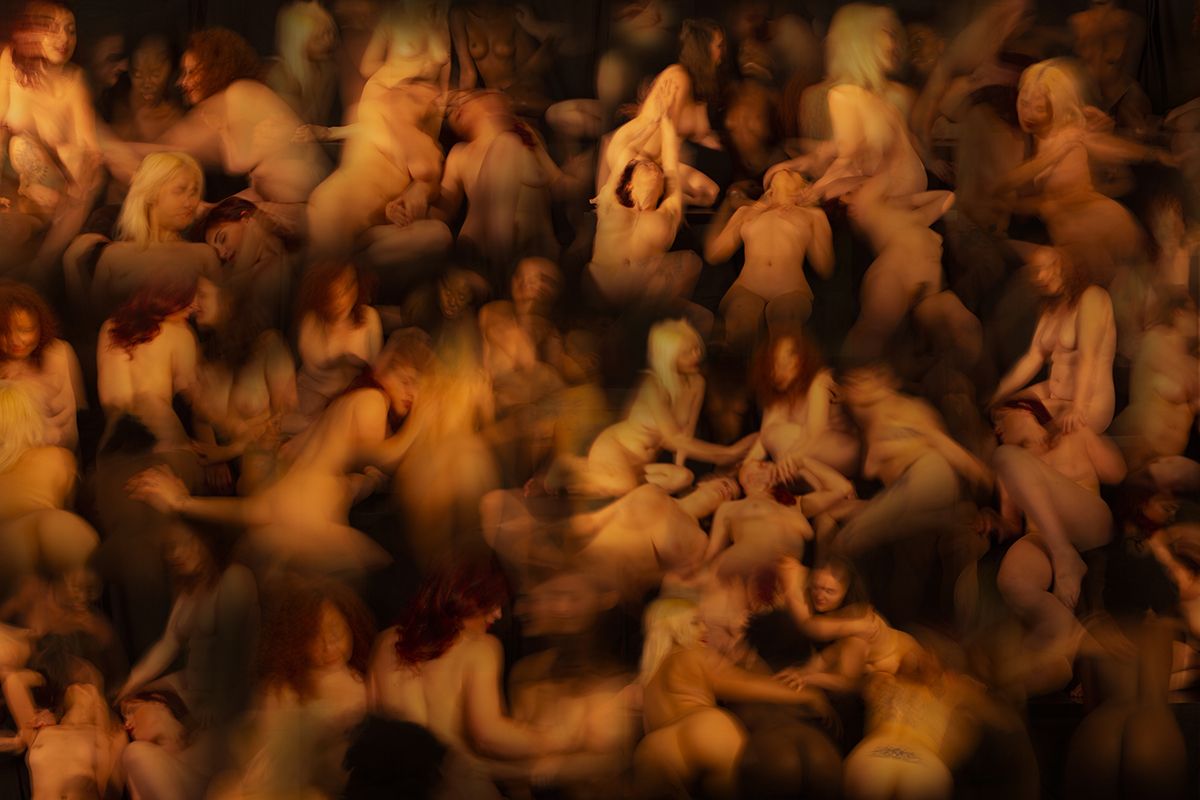
Originally conceived for development between 2021 and 2024, Carnations is a trilogy of chamber operas exploring the body and its sensory and social embodiments in the twenty-first century. The body, and particularly the naked body, lies at the heart of the visual and conceptual questions raised by these three works. They seek to establish, or perhaps restore, a place for flesh and embodiment on the stage of art music. Does music not seek to draw its audience towards itself — to make itself tangible by calling us closer?
In the world of so-called “serious” music, however, the established norm is an overdressed body. Formal costumes can dehumanise the sensitive individual, turning the musician into a robot, sometimes still wearing tails. Contemporary music concerts continue to follow a “Wagnerian” protocol. They are reduced to rituals: applause as musicians repeatedly enter and leave the stage, or a caricatured use of traditional instruments that turns performers into typists whose gestures are stereotyped. Spontaneity disappears. The performer is either motionless or driven into exaggerated, impossible postures, as though there were no balance between cadaverous stillness and the embodiment of a hysterical musician.
Digital tools contribute to this coarsening of both body and mind. On a touchscreen, five or six thumb movements can provide access to an almost infinite range of functions. Yet the mastery of gestures — technical, caring, everyday or musical — shapes our access to the world. The fewer gestures we command, the narrower our individual spheres of experience become. The restriction of muscular activity imposed by digital tools dematerialises our sensory contact with a world that requires an infinity of precise gestures to be fully encountered. Carnations responds to this dematerialisation by restoring the body to itself.
The project draws on three trilogies whose subjects cannot be exhausted by a single artwork. Its central inspiration is the collaboration between Mozart and Da Ponte: Le nozze di Figaro, Don Giovanni and Così fan tutte. Alongside these stand Paul Morrissey’s Flesh (1968), Trash (1971) and Heat (1972), and Pier Paolo Pasolini’s Trilogy of Life: The Decameron (1971), The Canterbury Tales (1972) and Arabian Nights (1974).
As an act of resistance, Carnations confronts the hypocrisy of censoring naked bodies on social media while advertising is hypersexualised, and the resurgence of a prudishness that instils guilt. Our relationship with our own bodies, and our social existence through them, has always been problematic. Although these questions have entered public debate, digital art often turns away from them in favour of idealised avatars. This trilogy seeks to bring the body back into dialogue on the contemporary music stage.
Sexuality is the prism through which Carnations examines embodiment. It receives and reflects a vast range of questions concerning the body, in ways that are at once intimate and universal. It offers artistic reflection the broadest expressive palette within the individual’s most inward experience.
Across its three parts, the trilogy seeks to dismantle patriarchal and masculinist conceptions of eroticism: through relationships between men and women, sexual orientation and gender identity, and the perspectives opened by queer thought.
- The first opera explores embodiment through romantic and sexual relationships between men and women, in the light of movements that have enabled women to speak out, including #MeToo.
- The second examines coming out and the forces of inclusion and exclusion surrounding it: discrimination, but also forms of self-segregation that gay and bisexual people may experience.
- The third follows the body’s search for gender — feminine, masculine or undetermined — and considers sex assigned at birth and intersex embodiment.
A new genre: interactive chamber opera
Opera has reinvented itself throughout musical history while retaining certain constants: costumed singers, a staged environment and instrumentalists, often assembled as an orchestra. It has therefore usually required large artistic forces, elaborate scenery and venues able to accommodate both performers and audiences.
Twentieth-century chamber opera opened a different path, with shorter works and smaller ensembles. Composers including Bruno Maderna, Luigi Nono, Wolfgang Rihm, Klaus Huber and Jonathan Harvey explored this reduced format. The twenty-first century adds a digital dimension: interactivity. This emerging genre requires research and experimentation in order to develop.
The first part of Carnations, provisionally entitled Don Juan libéré — Don Juan Liberated — places just two performers on stage: a singer and an actor. They share the same text, one speaking it and the other singing its principal lines of force. Together they embody one character: a Don Juan who harasses, rapes and kills. They move among prerecorded sound, digitally reworked photographs, interactive video and light. Their layered costumes gradually fall apart until they are completely naked.
The sung and spoken voice
The human body and its speech are central to Carnations. To give them priority, no musical instruments are played during the performance. Beforehand, the singer and actor record material using percussion and strings. These recordings form a sound reservoir from which an electronic score is composed to accompany their voices.
On stage, wireless microphones amplify their presence from a whisper to the full voice. They also allow sound to be positioned in space, bringing the performers acoustically closer to the audience. The physicality of emotional states becomes audible through speech, song and every sound produced through and by the body.
Between documentary and fiction
A guiding proposition for the project is: “Everything in life is about sex, except sex. Sex is about power.” In this reading, life is shaped by power and unequal relations, which often take a sexual form within patriarchy. Our visual culture is not outside these forces: it is conditioned by a dominant, normative perspective. The choice to examine the body through sexuality is therefore deliberate.
Feminist art and literary theory uses the term male gaze to describe the patriarchal perspective through which women, and the world more broadly, are represented. This visual culture encompasses artistic and commercial production: magazines, photography, cinema, advertising, video games and comics. The male gaze turns the female body into a standardised commodity, establishing a canonical ideal of beauty. The project examines the violence of such norms and their relationship to bodily dissatisfaction, psychological distress and imposed expectations concerning breasts, hips, body hair and skin.
Recent feminist movements, especially #MeToo, have brought the commodification of women’s bodies into public discussion. Through in-depth interviews with feminists and women who work with their bodies as models, Jacopo Baboni Schilingi began addressing these questions within the research for Carnations.
In Don Juan Liberated, nudity and the ways it is filmed and photographed are central artistic questions. The aim is to construct new references for representing the body, opening a space for the female gaze.
The trilogy belongs to fiction through its narrative form, but also follows a documentary approach. Its staging seeks new ways of apprehending embodiment, while interviews with women occupy a central place in the work.
Research as a method of creation
Jacopo Baboni Schilingi’s creative method is rooted in aesthetic research. Unlike experimentation, which remains open to an unknown and sometimes unexpectedly beautiful outcome, this research is guided by artistic hypotheses. Its purpose is not simply to prove or disprove them: they give the work a direction that runs across its different media.
Musical history offers many examples of this approach. Particular reference points are Schoenberg’s Moses und Aron and Monteverdi’s Orfeo, which address questions also raised by Carnations. Both pursue an aesthetic through investigation. Monteverdi seeks a balance between the libretto and musical writing, giving priority to the intelligibility and expressive force of the sung text. Schoenberg also explores the relationship between speech and song, notably through Sprechgesang, while twelve-tone writing opens new possibilities for musical listening.
Here, an actor and a singer embody the same text: one carries its dramatic and narrative stakes, while the other gives selected passages the expressive force of melody. This is the project’s first working hypothesis.
The second concerns the balance between humanity and technology, in both staging and musical composition. Digital technology belongs to the world in which these works are created: the project speaks of a world in motion. Yet it does not propose a transhumanist fusion in which technology becomes an enhanced extension of the human body. Body and technology retain their substantial independence — consubstantiation. They coexist and interact without becoming indistinguishable. The body expresses itself as a living presence and also through technology and its own logics.
The deepest hypothesis is that digital technology can enter artistic practice without reducing what the composer calls idiospheres: the distinctive, non-interchangeable gestures that make up an individual life. These gestures are shaped, among other things, by a person’s work. They may be compared with the sociological concept of habitus. Hyperindustrial society tends to standardise and diminish them.
The installation ARGO already explores this possibility. A device continuously measures the artist’s breathing; an algorithm follows the duration of breaths and the expansion and contraction of the chest. These data connect technology with one of life’s most intimate and fundamental processes. Converted into sound, they generate an endless music.
The research brings together different artistic media from the earliest stages of conception. Digital images, projected video, the representation of the contemporary body and the relationship between human presence and technical equipment are developed together. Nudity becomes a field of investigation, alongside the balance between screens, loudspeakers and living performers.
This method departs from the conventional separation of libretto, composition and staging. Writing, image-making and scenography develop simultaneously, before even a provisional libretto or a first musical note is fixed. The process itself enters the finished work through the reintegration of research and participants’ testimony. In particular, the final scene’s nine charges against Don Juan are to emerge from interviews with the women taking part in the project.
The first opera: Don Juan Liberated
The project contrasts the cultural prestige of Don Juan — the mythic hero whose violence towards women has so often been admired — with the figure of Violetta in Verdi’s La traviata, the woman labelled “fallen”. This contrast becomes a way of reading a changing society in which women can collectively say “Me too”.
Against the conqueror who seduces or violates women, with a sword or a chequebook, turning them into objects, domestic servants or mothers denied any other social role, other voices rise: women who have been dismissed and abandoned, and who can themselves desire, seduce and cause suffering.
To stage and compose Don Juan today is to engage fully with this context. The bloodshed can no longer be treated as a joke. Under pressure, Don Juan must change — and is offered the choice to do so. He must cease to be the harasser, rapist and murderer, becoming instead a man capable of loving as best he can, and therefore of suffering himself.
Music can make audible the contradictions running through society and through a modern myth such as Don Giovanni. Our understanding of love, and therefore of life itself, is changing. These transformations are the subject of the trilogy’s first part.
A first narrative outline
Overture
The singer and actor embody Don Juan in dialogue with three projection screens. The opening scene is static, paralysed by a tearing conflict of power: one must either accept it or resist it. It introduces the possibility of a liberating transformation. If Don Juan changes his own paradigm, he becomes a point of departure for social change precisely because he embodies what society must leave behind.
A dialogue between the judge and Don Juan gradually turns him towards Casanova. Following the perspective of Casanova’s memoirs, this figure is approached as a man conquered by a succession of women, each opening a different door onto life, as though they led the dance of an initiation. Such a Casanova would be a liberated Don Juan who has lost his former identity. His humanity is freed by women who leave their confinement crying “Me too”, discover their collective strength and, in emancipating themselves, emancipate others.
Without men’s participation, the struggle for women’s emancipation remains incomplete, because society as a whole must change. This is the position introduced by the opening scene.
The opera begins with the last scene of Mozart’s Don Giovanni, reimagined to make another form of redemption possible. The murdered Commendatore orders his daughter’s attacker to take his hand: “Give me your hand as a pledge!” This first utterance becomes the promise of a cursed union with the stone revenant whom Don Juan killed to save himself. Seduction and murder are bound together throughout the myth, up to the catalogue’s thousand and three women.
The Commendatore then demands repentance: “Repent!” Don Juan refuses: “I will not repent!” A woman’s voice interrupts, accusing him of destroying her by adding her name to his catalogue: “I am the thousand and fourth.” Another voice rises, then another, each announcing her number. Together they cry: “You kill us every day across the world. We bleed. You veil us. You prostitute us. Me too! Me too!”
Voices rise from graves until a Greek maenad appears: “In antiquity, we would have devoured you alive, Don Juan, in honour of Dionysus. But the great Pan is dead!”
Suddenly the Commendatore becomes a judge. He announces that Don Juan will be tried for millennia of crimes, reaching back to Abraham, whose voice is heard. “Your crimes are committed in the name of a love too great for a femininity that dazzles you, arrogant Don Juan! You cannot bear women’s pleasure, because you never find pleasure without them!”
A woman’s breathing builds towards orgasm and a cry. The demand is no longer that Don Juan repent, but that he emancipate himself. A woman sings: “Give me your hand, Juan!”
The opera’s development
From this hand extended by a woman, the opera moves through successive stages towards Don Juan’s trial, where he is once again asked to change.
He encounters women’s rejection of men, the collapse of his own destructive fantasies and the reality of women’s pleasure. He discovers the catalogue women make of their mediocre lovers. Prerecorded interviews bring their unvarnished testimony onto the stage: their understanding of eroticism, their worst and best sexual experiences, the harassment they have endured, and their thoughts about consent, seduction and femininity.
Finally, before a tribunal of nine women, Don Juan faces the catalogue of his abuses, from the most unobtrusive to the most violent. The opera closes on the possibility of profound social change, in which women and men alike could be freed from the chains of patriarchy.